What is a Disc Bulge?
A disc bulge (disc prolapse/herniation spectrum) occurs when the soft inner material of a spinal disc pushes outward and can compress nearby nerves. This often causes localized back pain, radiating pain (sciatica), numbness, tingling, or muscle weakness in the limbs depending on level (cervical, thoracic, lumbar).
Common symptoms
- Sharp or burning pain in the back/neck; radicular pain down arms or legs.
- Numbness, tingling or weakness in the distribution of the compressed nerve.
- Exacerbation with bending, coughing or prolonged sitting.
- Reduced mobility and guarded posture to avoid pain.
Ayurvedic perspective
Disc bulge is viewed primarily as a Vata disorder with local obstruction and Ama (toxic deposits) that aggravate Vata and compress nerves. The treatment emphasis: reduce nerve compression, pacify Vata, remove local toxins, nourish disc & paraspinal tissues, and restore spinal biomechanics.
How Ayurveda Approaches Disc Bulge
Our clinic combines conservative Ayurvedic local therapies, Panchakarma principles, herbal support and rehabilitation to:
- Reduce inflammation and nerve irritation
- Relieve muscle spasm and improve blood flow to discs and nerves
- Provide deep nourishment to spinal tissues (Asthi, Mamsa)
- Correct posture and strengthen supporting muscles to prevent recurrence
Clinic Therapies We Use for Disc Bulge (photos included)
Therapies below are selected for their effectiveness in reducing nerve compression symptoms, relieving pain and improving spinal function. Images are shown for reference.
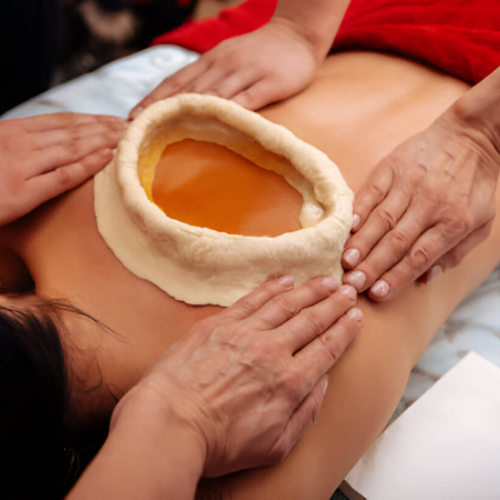
Kati Vasti Recommended
What it is: Warm medicated oil retained over the lower back in a dough boundary (kati ring) for a prescribed time.
- Direct, sustained heat + medicated oil penetration relaxes paraspinal muscles and reduces local Vata spasm.
- Improves local circulation and soft-tissue nutrition — helps relieve nerve compression symptoms.
- Indicated for lumbar disc bulge, chronic low-back pain, sciatica; typically repeated across several sessions for cumulative effect.
- Performed under physician supervision with tailored oils and timing to avoid overheating or skin issues.
Herbal & Oral Support — Safety & Red Flags
Oral herbs & supplements
- Dashmoola formulations: Classic Vata-pacifying anti-inflammatory support for spine disorders.
- Ashwagandha: Muscle tonic and nervous system support (improves recovery).
- Guggulu/Shallaki (Boswellia): Anti-inflammatory, helps reduce perineural inflammation.
- Topical medicated oils: Customized oils used during Vasti and external therapies for local penetration.
Red flags — when to seek urgent medical care
- Rapidly progressive weakness in legs/arms or loss of bladder/bowel control — seek emergency care immediately.
- Severe, escalating neurological deficit, high fever or signs of spinal infection — contraindication to many therapies until evaluated.
- If MRI shows large sequestrated disc with significant cord compression, neurosurgical consultation may be needed; Ayurveda can be adjunctive post-operatively.
We always assess neurological status and imaging reports (MRI) before initiating intensive therapies. Therapies are adjusted or withheld based on severity and red-flag signs.
Sample Clinic Plans for Disc Bulge
All plans are individualized — below are typical sequences used by our clinic depending on acute vs chronic presentation.
Acute Relief (7–14 days)- Rest, targeted Abhyanga (short), localized Swedan/Nadi Swedan
- Short course of Lepam & gentle traction guidance
- Pain-oriented herbs and anti-spasm measures (physician supervised)
Decongestion & Nourish (3–4 weeks)- Cycle of Kati Vasti & Prishtha Vasti (multiple sessions)
- Njavara Kizhi twice weekly, potli therapies
- Begin guided physiotherapy & core stabilization
Rehabilitation & Maintenance- Gradual strengthening program, monthly maintenance Vasti/Abhyanga
- Long-term oral rasayanas & ergonomics counseling
- Periodic reassessment and imaging if symptoms change
Panchakarma procedures (Basti) are prescribed after preparatory measures and medical clearance. Response is monitored daily; therapies adjusted based on symptom change.
Quick Reference — Therapies & Roles
| Therapy | Primary role in Disc Bulge | Typical use |
|---|
| Kati Vasti | Local sustained oil retention — relaxes muscles & reduces nerve irritation | Core targeted therapy for lumbar disc bulge |
| Prishtha Vasti | Posterior nourishment, facet & paraspinal support | Thoracic/lumbar involvement |
| Greeva Vasti | Cervical nerve root relief | Cervical disc bulge |
| Njavara Kizhi | Tissue nourishment & Vata pacification | Subacute/chronic phases |
| Nadi Swedan | Local heat, adhesion softening | Before oil retention therapies |
| Basti | Systemic Vata pacification | Selected chronic cases after evaluation |
Ready to ease your disc pain and get moving again?
Book a consultation — we will review your symptoms, neurological status and imaging (if available), and design a safe, stepwise Ayurvedic plan combining targeted therapies, herbs and rehabilitation.
Book ConsultationAll therapies are performed by qualified Ayurvedic physicians. If red-flag neurological symptoms exist we will coordinate urgent medical care first.